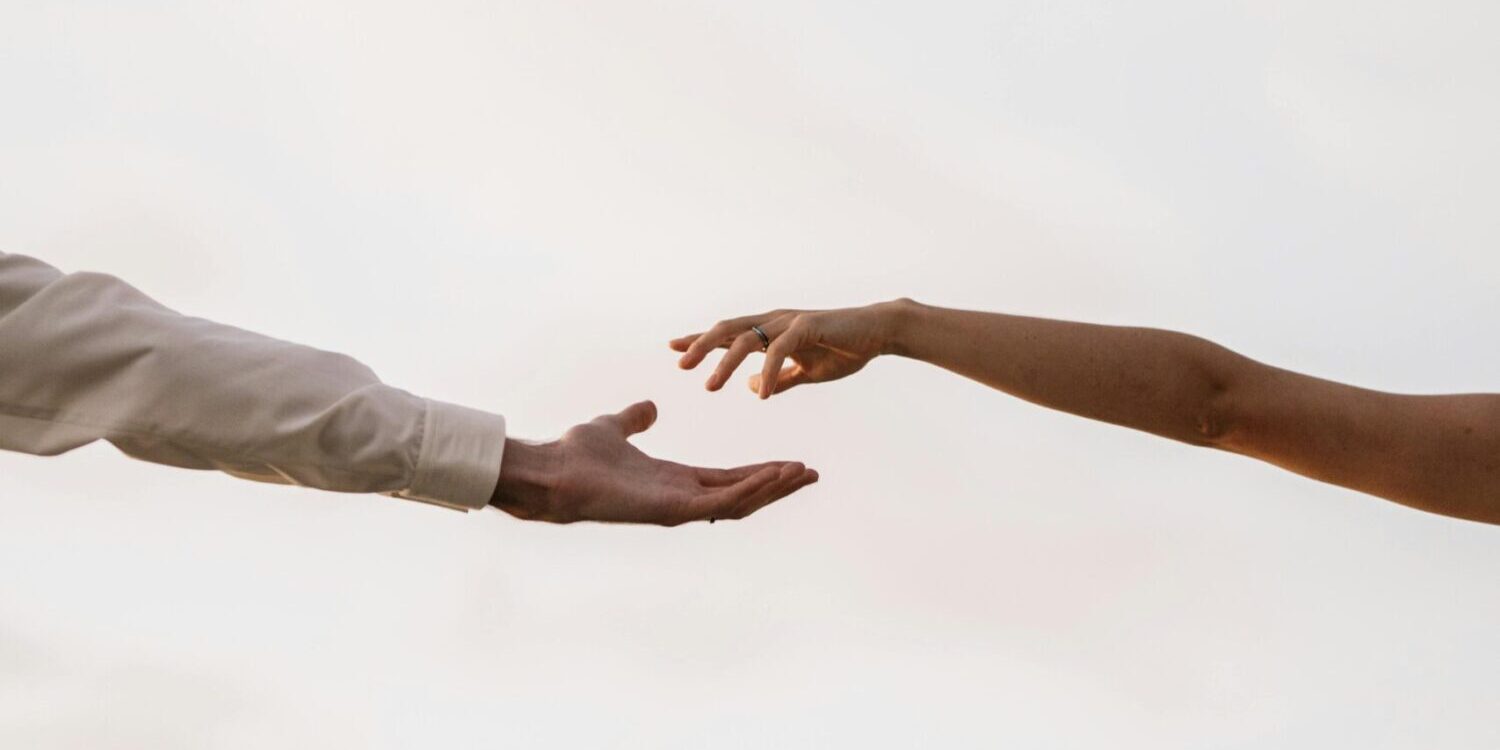
We want to be chosen. We want to feel that, in the crowd, someone sees us, privileges us, places us at the center of their map of the world.
The other side is discussed less: choose.
Making a choice, deciding on a path, also means closing doors: Giving up certain opportunities and taking responsibility: “This is where I make my presence felt; this is the person I choose to play with tomorrow.”
In the age of apps, expatriation, and options at our fingertips, this "decision" carries more weight than before. We no longer simply choose someone; we give up everything we could still living elsewhere.
That's where the fear arises: what if we've got the wrong person, the wrong city, the wrong life?
However, at one point, Every profound choice involves renunciation.
1. Choose: stop Volatile to create Solid
At the start of a meeting, everything remains open: we talk, we explore, we test the presence of the other in our days, in our thoughts, in our projects.
Then comes the moment when the question changes: it's no longer "do I like this person?",
but “Do I really want to make room for this person in my life?”
This changeover implies 3 very concrete renunciations:
-
Give up the collection of options in the background: those lukewarm conversations, those plan Bs, those "just in case" contacts.
-
Give up the illusion that everything is always open: accept that a real bet requires putting chips in the middle of the table.
-
Give up some of your solitary comfort: admit that a presence at this level influences schedules, decisions and travel.
It's not a punishment; it's the natural price of a meaningful relationship. The problem doesn't lie in the act of giving up something. It lies in the fear of losing it. by attaching : freedom, intensity, future possibilities.
2. Not to choose: to suffer
People often think they're "saving time" by leaving everything open. In reality, Not taking a decisive step also shapes a trajectory and reveals underlying attitudes:
-
simple, light-hearted stories,
-
you spend years half-invested,
-
we keep doors ajar that never lead to a real story.
We tell ourselves we don't want to give up. In fact, we're already giving up all these possibilities by remaining paralyzed in the face of options:
-
to the experience of a truly profound alliance,
-
the inner stability that comes with making a choice,
-
to the power of a life organized around a clear "yes".
At this standard of living, luxury is no longer about having an infinite number of options, it's about daring to... really invest one of them, knowingly. The question then becomes: “What am I giving up by remaining undecided?”
3. Every choice closes some doors... and opens others
Every serious choice closes off possibilities. This is true for a city, a career, a project. It's even truer for a partner.
Saying "yes" to someone means saying "no" to other stories, other versions of yourself, other scenarios. It's not a tragedy: it's the very movement of adult life.
The key lies elsewhere: For whom do I really want to close certain doors?
A good choice in love doesn't have to be a bitter sacrifice. The only "bad choice" is the "non-choice." We can regret our choices, we can make mistakes, we learn... that's the very essence of life. Indecision leaves the remorse of not having seized the opportunity to experience a beautiful love story; it's simply enduring existence.
Conscious choice resembles a realization with greater depth and intensity :
– less dispersion, more density,
– fewer abstract options, more concrete solutions for two,
– less “what if…”, more “let’s go, right now”.”
We renounce the fiction of all possible lives in order to inhabit a real, embodied life with one particular person.
And if it is frightening, it is often because we finally realize the value of what we put on the table: our time, our energy, our freedom.
4. How do we know if this person deserves our commitment?
The fear of making a mistake isn't there to sabotage. It also serves to ask a cold, essential question: “Does this person really deserve for me to give up other options to move forward with them?”
Here are a few concrete points of reference:
-
Inner Clarity
When we imagine what the future holds with this person, does something within us calm down, even if everything isn't resolved?
Or does everything become tense as soon as we think of "commitment"? And why? -
Quality of the exchange
Can we speak truthfully, name the issues, the doubts, the desires?
Or do we constantly feel tense for fear of breaking something fragile? -
Trajectory for two
Does this person lift our lives up, even slightly?
Or do we already sense that we will have to shrink, adapt, slow down, in order for it to "hold"? -
Deep resonance
When you remove the context, the status, the setting: does this person resemble a travel partner, or a pleasant interlude that you are afraid to close?
Renunciation then becomes a key factor:
If, upon looking at it, the idea of closing certain doors creates a feeling of’expansion Even with a bit of stage fright, the challenge is worth exploring.
If, on the contrary, the mere idea of commitment creates a feeling of shrinking, of permanent concession, of life in decline, then the doubt does not speak of fear of commitment in general.
He's talking about a No who doesn't dare to speak out.
Conclusion: choosing someone is also choosing yourself
Choosing a partner is not just about saying “yes” to the other person.
It's saying "yes" to the person you become by their side.
Ultimately, the real question is not: “What if I closed myself off to something better?”
It looks more like: "Does this covenant allow me to inhabit my life on my true level, or am I preparing for a lukewarm existence by keeping everything half-open?"
From then on, giving up is no longer a punishment. It's an act of sovereignty: closing doors to open one, fully, with someone who truly deserves our entire presence.
If you feel stuck between several options without ever really deciding, book a time slot:
Access to Click
You leave your first name, your email, you click.
The future won't wait for you.
The 5 pitfalls of Smart Singles
Why brilliant people never meet — and how to reverse the trend. The guide, free.
Receive the guide